

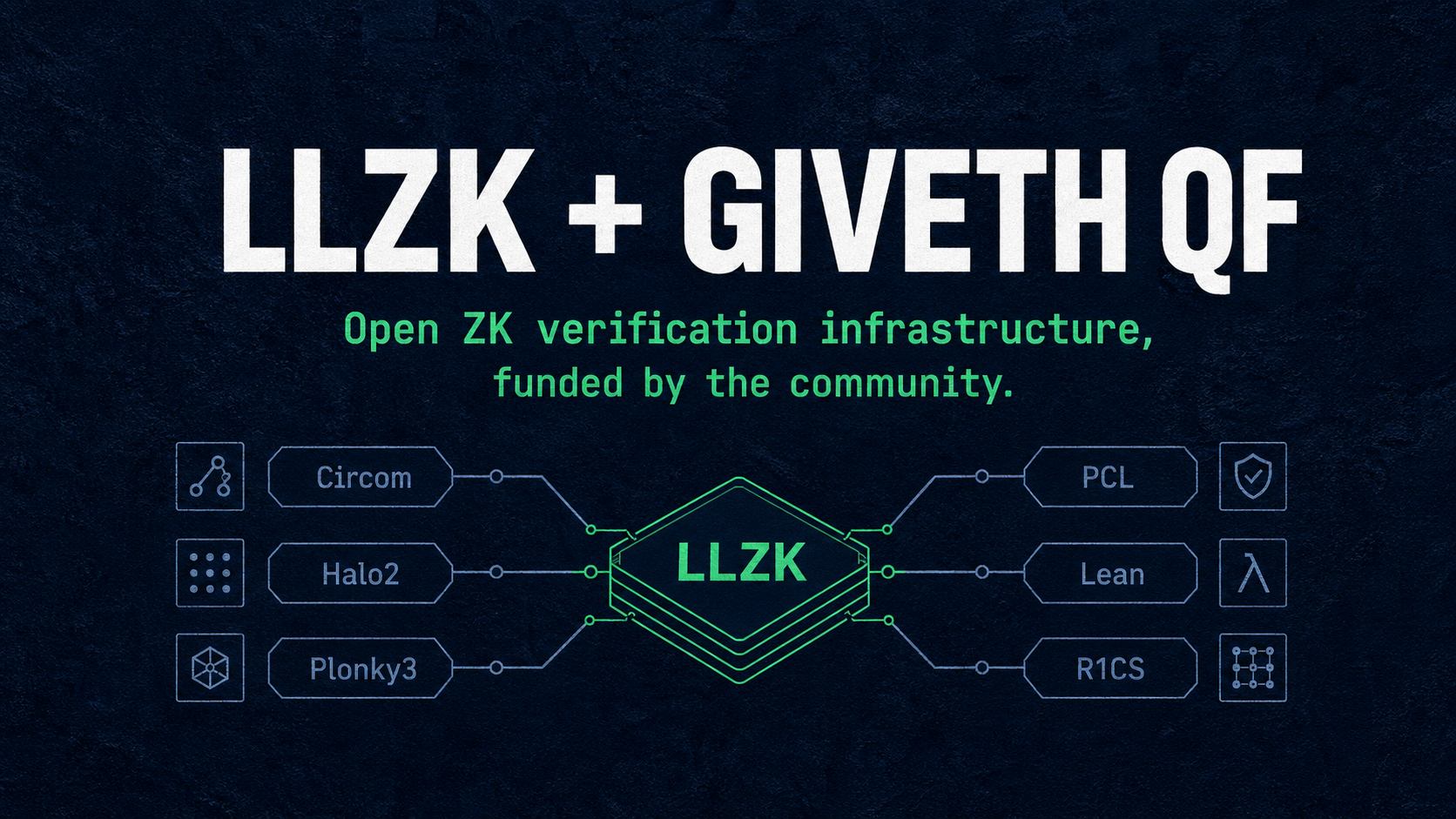
LLZK, the open source compiler framework for zero knowledge circuit verification, has been accepted into TheDAO Security Fund’s first decentralized funding initiative on Giveth. The round uses quadratic funding to allocate 500 ETH ($1M) across projects strengthening Ethereum’s security ecosystem, and LLZK is one of them.
TLDR
- LLZK accepted into TheDAO Security Fund’s QF round on Giveth.
- 500 ETH ($1M) matching pool for Ethereum security projects.
- Quadratic funding rewards breadth of support, not donation size.
- Funds will harden LLZK pipelines, SMT backends, and core infrastructure.
- Round runs through May 14, 2026
- Donations and GitHub contributions both move the project forward.
What is LLZK
LLZK is an open source compiler framework that translates ZK circuits from multiple frontends (Circom, Halo2, Plonky3, with a Noir frontend in active development) into a shared intermediate representation built on MLIR. From there, circuits can be lowered into formal verification backends, including PCL for use with Picus, Lean based representations such as zkLean, and R1CS.
The point is not just to compile circuits. The point is to reason about them. LLZK enables determinism analysis, soundness checks, unconstrained signal detection, and other security critical passes across ecosystems that today have no shared verification layer.
Veridise uses LLZK internally as part of its verification pipeline. It is the layer that allows Picus to analyze circuits from zkVM systems like RISC Zero and SP1, and it is what makes uniform analysis across Circom, Halo2, and Plonky3 possible in the first place.
What quadratic funding actually does
Quadratic funding is a mechanism designed to amplify broad community support over concentrated wealth. The matching amount each project receives is calculated from the square of the sum of square roots of contributions. The number of unique donors matters more than the size of any single donation.
Here is what that looks like in practice:
- Project A receives $500 from one donor. The matching formula gives it roughly $500 in matched funds.
- Project B receives $5 from 100 different donors, also $500 raised. The matching formula gives it roughly $50,000 in matched funds.
Same total raised. A 100x difference in matching. That is the design. It rewards projects that can demonstrate broad ecosystem buy in, which is exactly the signal public goods funding is supposed to capture.
For LLZK, this means a $5 donation carries real weight. It is not symbolic.
What does the funding supports?
The grant scope is maintenance and ecosystem integration, not new project creation. LLZK already works. The goal is to make it reliably usable as public infrastructure. Three priorities:
End to end verification pipelines. Documented, runnable workflows that take a circuit from Circom, Halo2, or a zkVM IR through LLZK and into PCL or Lean. A unified CLI, working examples, tagged releases.
Expanded SMT backends. New lowering passes for bitvector encodings, finite field aware encodings, and optimized integer encodings, evaluated against real world circuit benchmarks. The goal is to let users check circuit properties with off the shelf SMT solvers.
Core infrastructure hardening. Resolving open issues in the public tracker, expanding test coverage, upgrading MLIR/LLVM to take advantage of the SMT dialects added in MLIR 21, refining error reporting and APIs.
Why this matters for Ethereum
Modern Ethereum scaling depends on increasingly complex ZK circuits across rollups and zkVMs. Verification tooling, however, is fragmented across frameworks, and the most dangerous bug class in ZK, underconstrained circuits, accounts for over 96% of real world ZK circuit layer vulnerabilities. A shared verification layer lowers the cost of applying formal methods to these systems and makes verification reusable across proving systems instead of locked to one toolchain.
That is the case for LLZK as a public good, and it is the case for funding it that way. Quadratic funding makes small donations matter more than they look, because matching is driven by the breadth of community support rather than the size of any individual contribution. Whether through a donation or a contribution to the public repo, supporting LLZK directly strengthens the verification infrastructure available to ZK teams across the ecosystem.


